

A messy origin story: Bandai Carddass beats the TCG to print
Start with a date and a product line. In late September 1996 Bandai released the Carddass Pocket Monster “Green Version” and similar Carddass sheets in Japan. These were not a collectible game by modern TCG standards but a line of trading and sticker-style cards that featured Pokémon artwork and stat-like numbers. They appeared months before any rule-driven Pokémon Trading Card Game sets, and crucially they were the first commercially printed Pokémon cards aimed at kids in Japan.
Carddass cards were part of a larger, established Bandai business; Carddass had produced licensed collectible cards and stickers for anime and entertainment properties for years. The Pokémon tie-ins simply joined that roster at the moment Pocket Monsters exploded on television and in games. These early pieces frequently carried simple illustrations and production values more like promotional collectibles than packaged game cards, but their existence matters because they predate what hobbyists later locked in as the official TCG timeline.
Why the distinction matters: historians and collectors draw a line between ‘first printed card with Pokémon on it’ and ‘first card in the trading card game that people would recognise as cards to play with.’ Bandai’s Carddass entries occupy the first category. Their rarity today stems from limited distribution, ephemeral retail placement, and the fact that they were produced in a market that moved quickly on to later products.
This origin knocks down a neat myth — Pokémon cards didn’t begin when Western boosters first hit shelves. They began in Japanese kids’ culture as part of a broader merchandising flood, and you can still find Carddass pieces in private collections and auction catalogues, often graded when they survive in high condition. The exact artwork and variant naming conventions can be confusing; collectors rely on physical details and provenance to separate Carddass from later TCG printings.
CoroCoro and the first TCG-style promos: Pikachu and Jigglypuff inserts
A different trailhead appears in the pages of CoroCoro Comic, a mass-market Japanese monthly aimed at young boys. In October and November 1996 issues, CoroCoro included small card inserts and promotional strips featuring Pokémon characters. These inserts are widely cited by collectors as the first examples of what looks and feels like modern TCG cards — glossy, single-card promos with familiar Pokémon art.
One Reddit thread that stirred the community points to Pikachu and Jigglypuff inserts from the November 1996 issue; these were distributed publicly and seen by a large audience. Their date matters because they show an evolution from Bandai’s general Carddass approach to something more like the trading-card experience: single-card promo distribution, collectible appeal, and positioning alongside other licensed merchandise. CoroCoro’s reach meant these promos were widely seen by the show’s audience and contributed to demand and recognition.
CoroCoro promos are a transitional artefact. They’re not full game-set cards in a rulebook sense, but they’re closer to promo singles and are the earliest widely distributed, recognisable Pokémon cards. As such they carry a particular kind of collectibility: they’re historically significant, often scarce, and sometimes show minor printing variants tied to specific magazine runs. Collectors who chase the ‘firsts’ will look for corroborating evidence — cover dates, publisher stamps and original magazine copies — before accepting provenance.
The CoroCoro pieces help explain why the narrative around the first Pokémon card is blurred. Different collectors prioritise different criteria — printed image, public distribution, or inclusion in an actual card game — and CoroCoro sits precisely on that dividing line.
The Japanese Base Set and the birth of the TCG as a game
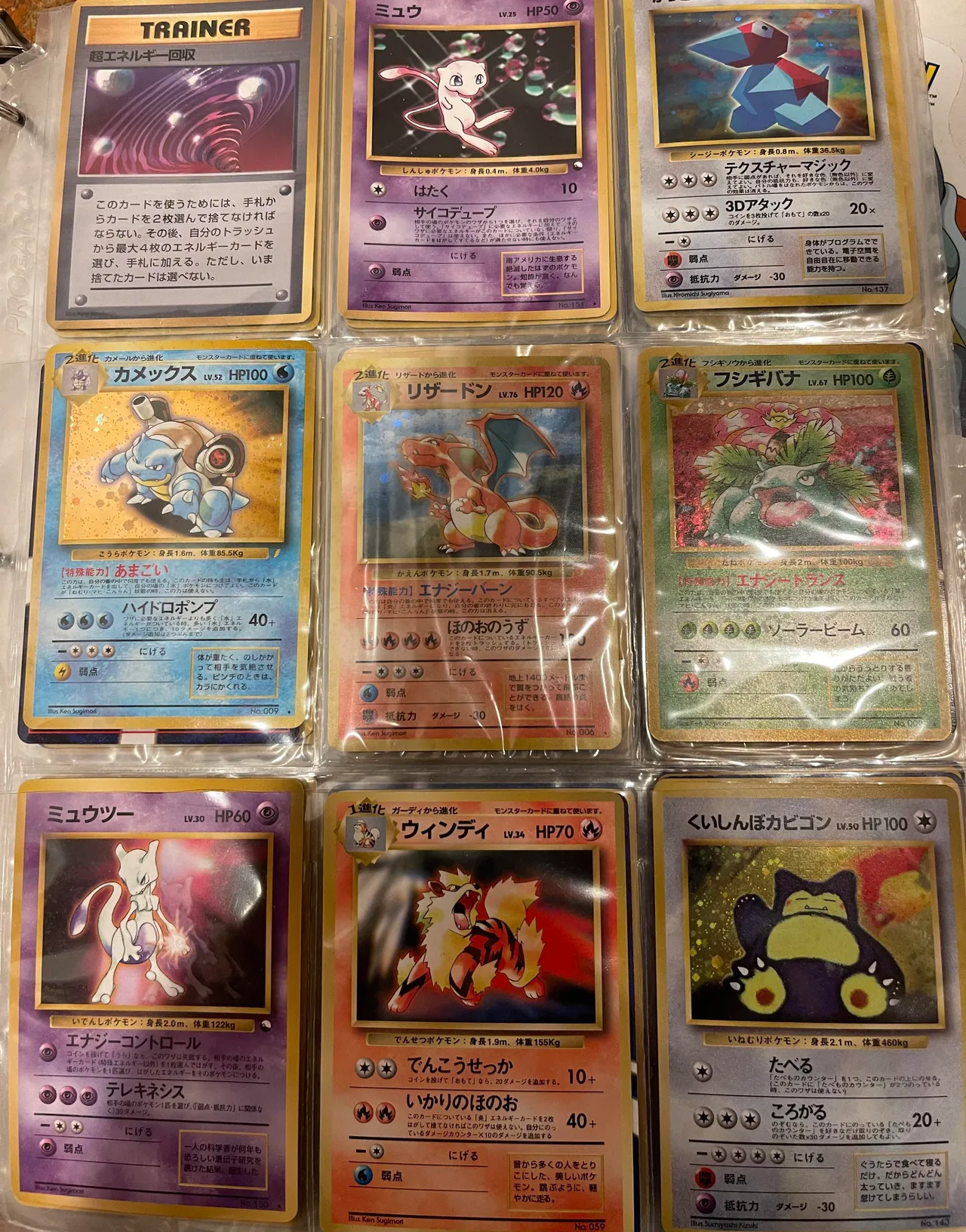
By late 1996 and into 1997 a proper trading card game began to take shape. The Pokémon TCG as a rule-based product was developed with artwork from Ken Sugimori, Mitsuhiro Arita and Keiji Kinebuchi and released in formal sets. Bulbapedia and contemporary sources trace the genesis of the TCG to these Japanese Base Set releases that followed the initial promotional activity.
This is where the hobby shifts from novelty to system: cards carried attacks, HP, energy costs and clear rulings for play. The Japanese Base Set provided the template — artwork, rarity symbols, and booster packaging — that the western market would later import. For many collectors the Base Set is the meaningful ‘first’ because it introduced the mechanics that define what a trading card game is: deck-building, standardized card backs, and organised distribution channels through booster packs and starter decks.
The makeup of those early cards also helps explain modern valuations. Early print runs, symbol variants and misprints have become points of interest for graders and auction houses. The global breakthrough came later, when Wizards of the Coast licensed the game for English-language release in 1999 and published the Base Set that most international collectors recognise. But without the Japanese Base Set’s game rules and packaging, the card market would have been stuck at collectible stickers and magazine promos.
This section draws a line between printed memorabilia and playable cards: the Japanese Base Set is where the Pokémon trading card game — as a rule-governed hobby — was first available in a packaged, sellable, repeatable format.
1999 international Base Set: when the world started treating cards as a market
The 1999 English-language release of the Base Set — handled by Wizards of the Coast under licence — is the clean break for most international collectors. When that product arrived in the UK, US and Europe it transformed Pokémon cards from regional curios into a global market commodity. Retail distribution, tournament play and secondary markets followed quickly.
Unlike magazine inserts or niche Japanese printings, the international Base Set came with an established distribution model: sealed booster boxes, starter decks, and wide retail presence. That scale created the conditions for a secondary market. People began buying sealed product as speculation, singles were pulled and traded, and a graded-card economy eventually emerged. The difference between a magazine promo and a minted English Base Set holographic is not just nostalgia — it’s supply. English Base Set print runs were substantial, yet demand outstripped supply in many markets, which created the first real speculative bubbles around Pokémon cards.
Market practice also changed: eBay and local trading forums (and later specialist marketplaces) standardised how cards were priced and sold internationally. In the UK context, eBay listings and dedicated sites like CardTrader began to show price signals for sealed boxes versus graded singles. The 1999 Base Set is the origin of those price graphs: once a mass-market product exists in sealed and loose forms across multiple countries, collectors and traders can compare, grade and monetise rarity.
So while the first printed Pokémon images go back to 1996 Carddass sheets and CoroCoro promos, the international Base Set of 1999 is where a durable, measurable market for Pokémon cards really began.
How collectors and markets treat ‘first’ cards today
The question ‘what was the first Pokémon card?’ still sparks debate because collectors measure ‘first’ differently. Some care about the very first printed depiction of a Pokémon on cardboard (Bandai Carddass). Others prioritise the first public promo distribution (CoroCoro inserts), and many emphasise the first rule-backed trading cards (Japanese Base Set and the 1999 international Base Set). Each choice changes which physical object is considered the prize.
Market behaviour reflects those distinctions. Carddass and CoroCoro pieces trade as niche, high-provenance items and often fetch interest from historical collectors and Japanese-pop-culture archivists. Conversely, early TCG Base Set holographics and English 1999 cards drive mainstream enthusiasm and the broader graded-card market. Supply-side factors — original print quantity, how cards were distributed, how many survived in good condition — shape prices. Magazine inserts often had tiny runs and poor storage circumstances; boosters and starter decks were produced more widely, but play reduced the population of mint examples.
Grading plays a role in certifying these early issues. When a properly authenticated CoroCoro insert or Carddass card receives a high grade from a respected grading company, it shifts from an obscure curiosity to a verifiable collectible. UK and international marketplaces respond: auction houses, specialist dealers and online listings separate sealed lots from raw singles and note provenance heavily in descriptions.
Finally, the study of the earliest Pokémon cards is ongoing. New finds in private collections, better documentation from Japanese publishers, and community-driven research continue to refine the timeline. What won’t change is that the origin story is layered: the first printed Pokémon images, the first widely distributed promos, and the first true TCG sets arrived in quick succession between late 1996 and 1999, each playing a distinct role in the hobby’s rise.
Key takeaways
- The earliest printed Pokémon cards were Bandai Carddass products released in Japan in late September 1996.
- CoroCoro Comic promos and inserts from October–November 1996 are among the first TCG-style cards seen publicly.
- The Pokémon TCG as a game began with the Japanese Base Set (1996–1997) and the internationally famous Base Set release in 1999.
- Collectibility depends on rarity, distribution method (magazine insert vs. booster), and condition; sealed product markets differ from singles.
- Historical clarity matters: “first card ever” can mean first printed image, first promotional insert, or first TCG card distributed in packs.
FAQ
- Were there Pokémon cards before the official TCG?
- Yes. Bandai produced Carddass Pokémon cards in Japan first, released in late September 1996. These were collectible trading cards but not the rule-driven trading card game that later became the Pokémon TCG.
- Which card is commonly called the first Pokémon TCG card?
- Collectors often point to early CoroCoro Comic promo cards (for example, Pikachu or Jigglypuff inserts from October–November 1996) as the first TCG-style cards seen by the public, while the Japanese Base Set and subsequent 1999 international Base Set are the first full TCG releases.
- Did the Pokémon Company or Wizards of the Coast make the first cards?
- Bandai and Japanese magazines published the earliest printed Pokémon cards. The Pokémon Company (and Nintendo/Creatures/Game Freak partnerships) later authorised the Pokémon TCG; Wizards of the Coast handled the western release starting in 1999.
- How does early scarcity affect value now?
- Scarcity is shaped by original print runs, how the cards were distributed (magazine insert versus booster), survival rates, and condition. Magazine inserts and promotional pieces often had small print runs and can command higher prices on secondary markets.
- Are these 1996 cards commonly found graded or sealed?
- It’s unusual to find large numbers of mint-graded 1996 Carddass or CoroCoro inserts; most surviving examples show wear. Sealed contemporary Japanese product is rare and typically trades at a premium compared with loose singles.
Sources
External research and reference links used for this article.
- Pokémon Trading Card Game - Bulbapedia, the community-driven Pokémon encyclopediahttps://bulbapedia.bulbagarden.net/wiki/Pok%C3%A9mon_Trading_Card_Game
- What was the first Pokémon card? History and valuehttps://rarecards.nl/en/blogs/tcg-blogs/wat-was-de-eerste-pokemon-kaart
- r/VintagePokemonCards on Reddit: First Pokemon TCG cards everhttps://www.reddit.com/r/VintagePokemonCards/comments/1pi4dro/first_pokemon_tcg_cards_ever/
- When Did Pokemon Cards First Come Out? (History of The TCG)https://cardcollector.co.uk/when-did-pokemon-cards-come-out/
- When Did Pokémon Cards Come Out: The Official Launch Datehttps://japan-figure.com/blogs/news/when-did-pokemon-cards-come-out